Hoses · Failure analysis
Why Hydraulic Hoses Fail — And How to Read the Evidence
Abrasion, impulse fatigue, heat aging, bad routing, wrong crimps: the seven real causes of hydraulic hose failure and what the failed hose tells you about each.
Published June 22, 2026 · Last updated July 6, 2026 · By the A1 Hydraulic Power Solutions team
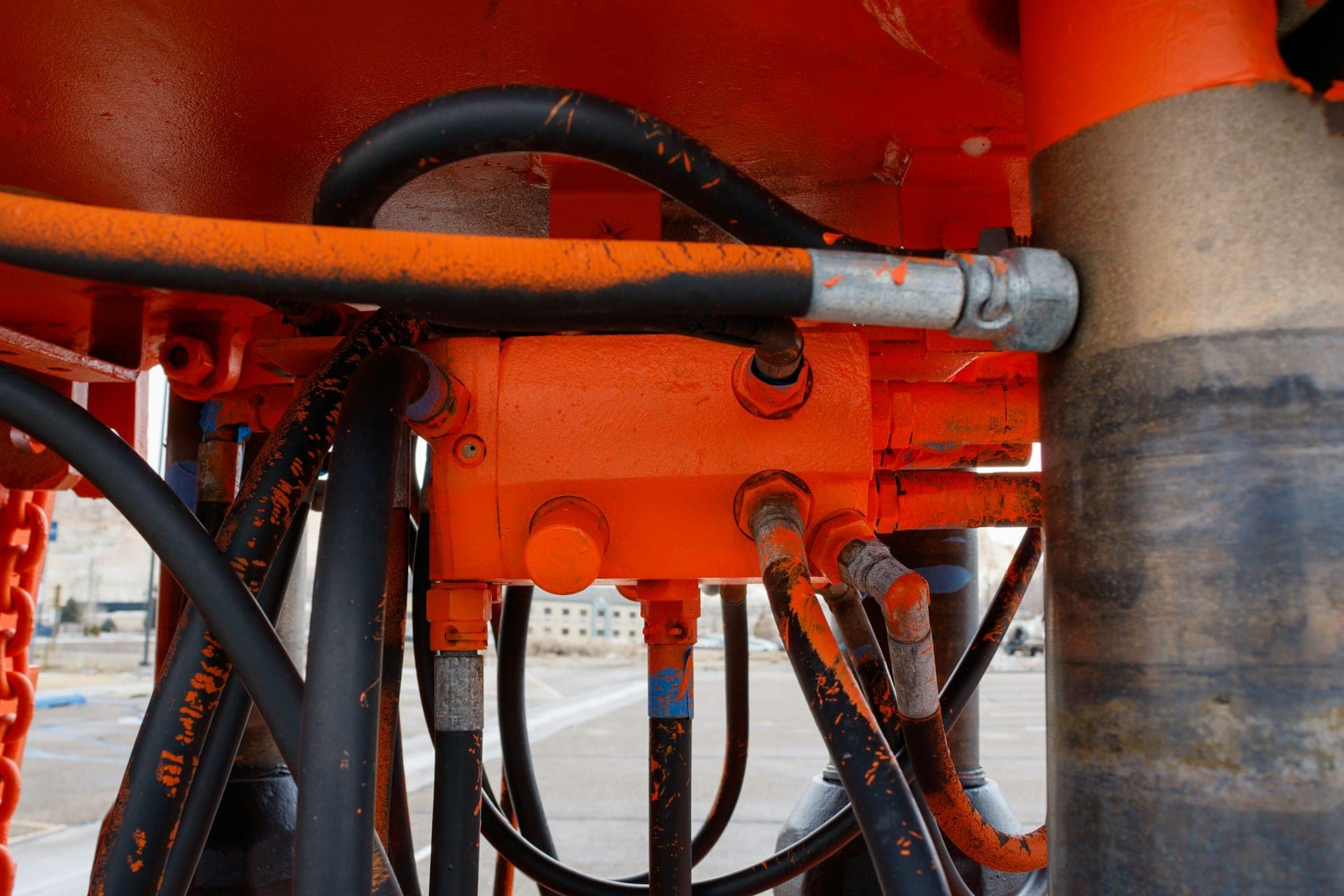
A failed hydraulic hose is a witness. The way it let go tells you exactly why it let go — and whether the replacement will last five years or five weeks. After fifty years of post-mortems at our Fort Worth counter, the causes sort into seven patterns, and only one of them is "the hose was old."
1. External abrasion — the slow saw
The evidence: cover worn through in a patch, wire braid visible and frayed, failure at the rub point.
The number-one killer of mobile-equipment hose isn't pressure — it's the hose sawing against a frame rail, a clamp edge, or its neighbor ten thousand times a day. Once the cover is gone, the reinforcing wire corrodes and abrades until the pressure finds it.
The fix costs almost nothing: abrasion sleeve, spring guard, and honest routing practice. We stock all of it alongside the clamps.
2. Impulse fatigue — the invisible one
The evidence: a clean burst mid-hose, often near a fitting, on a hose whose cover looks nearly new. Wire ends show fatigue fracture, not abrasion.
Every pressure spike flexes the reinforcement. Braid constructions fatigue at the wire crossover points; that's why high-cycle circuits specify spiral hose, whose plies don't cross. If an excavator's main circuit keeps eating two-wire hose, the answer isn't a third replacement — it's the construction the OEM specified in the first place. See wire braid vs spiral.
3. Heat aging — the crispy tube
The evidence: cover hard and cracked, tube brittle and checked when you flex a cut end, failure by cracking rather than bursting.
Rubber hose is rated to about 212°F continuous. Run it draped over a turbo, or run the system hot because the cooler is fouled, and the elastomers cook. A hose that fails crispy is telling you about the system's temperature, not the hose's quality.
4. Wrong hose for the job
The evidence: collapsed tube on a suction line; burst on a pressure line rated below the circuit; blistered cover from a fluid the tube couldn't handle.
The classics: pressure hose on a pump inlet (no helix — it collapses under vacuum, the pump cavitates, and now you're buying a pump: see SAE 100R4); R1 hose on an R2 circuit; non-compatible tube with water-glycol or ester fluids. The layline on the old hose and the circuit spec settle all of these before purchase.
5. Bad crimp or wrong fitting
The evidence: the fitting blew off the hose, or leaks trail from the crimp shank.
A crimp is a precision joint: the right ferrule, the right dies, the right final diameter, verified with calipers. Braid-hose ends crimped on spiral hose, mismatched ferrule series, or a "field fix" with a worm clamp all fail the same way — suddenly. This is why every assembly we build gets its crimp diameter checked against spec before it leaves the bench, and why spiral hose gets interlock ends without exception.
6. Twist — the 7% killer
The evidence: failure spiraling along the hose; the layline wraps around the hose like a barber pole instead of running straight.
A hydraulic hose is built to bend in one plane, not to be wound up. Industry testing has long shown that even a few degrees of installed twist cuts service life dramatically — a 7° twist can take away most of it. The layline is the tell-tale: if it corkscrews, the installer twisted the hose while tightening. Hold the hose, turn the swivel nut.
7. Age and shelf life — last on the list for a reason
Rubber hose does age, and a decade-old hose deserves suspicion. But age is our least common finding — the six causes above almost always get there first. Replacing hoses on a calendar while ignoring routing and temperature treats the symptom and reruns the failure.
Reading your own failure
Cut the failed section out and look:
| Finding | Probable cause |
|---|---|
| Cover ground away at one spot | Abrasion — fix the routing |
| Clean burst, good cover | Impulse fatigue or under-rated hose |
| Hard, cracked cover | Heat — check system temp and routing |
| Collapsed or flattened tube | Suction duty without a helix |
| Fitting separated from hose | Crimp or fitting-series error |
| Spiral failure line / twisted layline | Installed twist |
Then bring the evidence to us. Matching the old assembly is a two-minute job at the counter — or spec the replacement online — and the diagnosis of why it failed comes free with it. A replacement without a diagnosis is just a scheduled repeat.
Put it to work.
Reading about it is half the job. For the other half, the counter is at 2201 Handley Ederville Road, Fort Worth — or start online.
 Lou Einstein