Hoses · Sizing
Hydraulic Hose Dash Sizes Explained (With Charts)
What -4, -8, and -16 actually mean, how dash size relates to inside diameter and flow, and how to size a hydraulic hose so it doesn't overheat your system.
Published May 18, 2026 · Last updated July 6, 2026 · By the A1 Hydraulic Power Solutions team
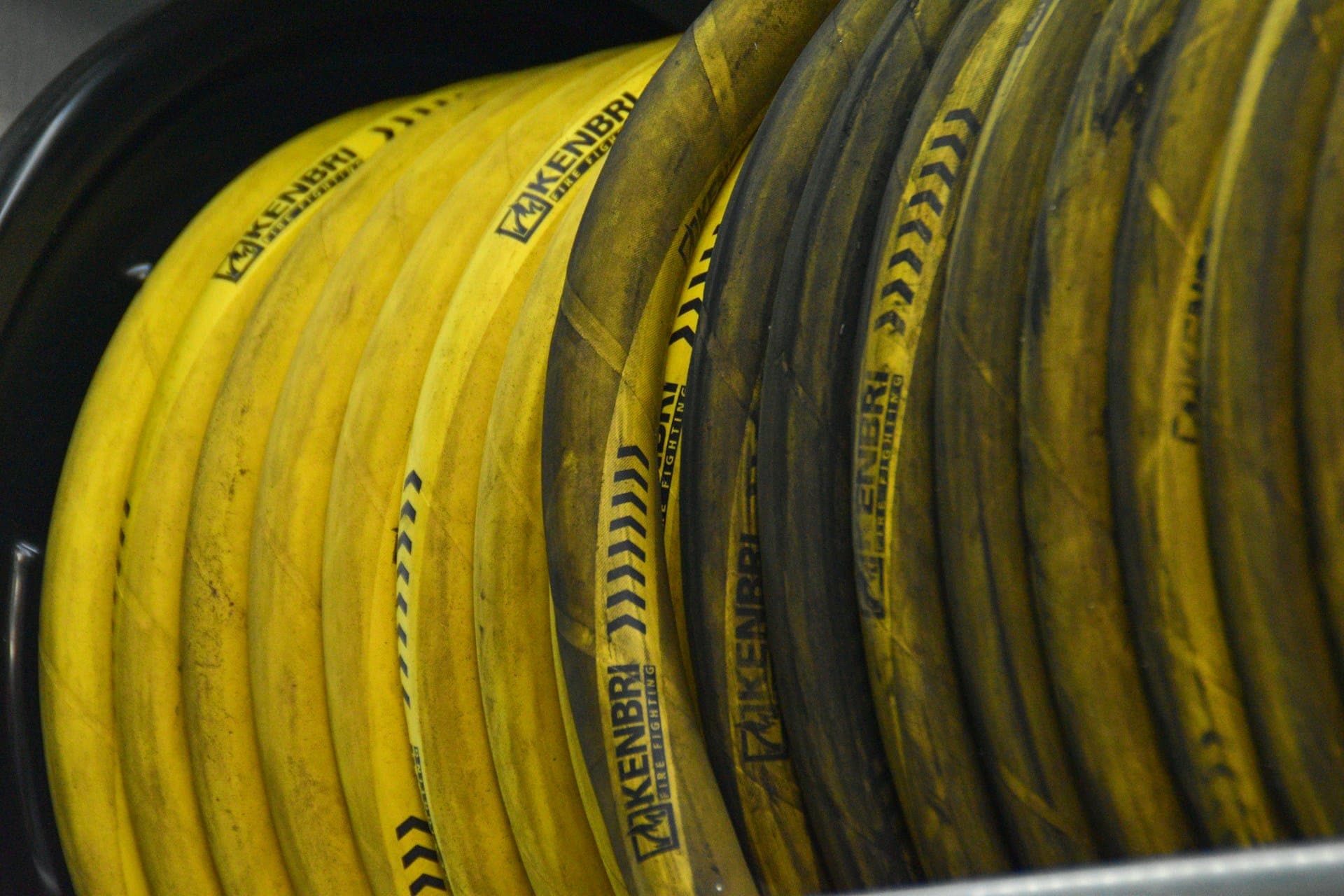
Every hydraulic conversation eventually produces a phrase like "dash eight" — and everyone nods, including the people guessing. Here's the whole system, minus the guessing.
The system: sixteenths of an inch
A dash number is the hose or fitting's nominal inside diameter in sixteenths of an inch. Divide by 16 and you have it:
| Dash | ID (inches) | ID (mm, approx.) |
|---|---|---|
| -4 | 1/4" | 6.4 |
| -6 | 3/8" | 9.5 |
| -8 | 1/2" | 12.7 |
| -10 | 5/8" | 15.9 |
| -12 | 3/4" | 19.0 |
| -16 | 1" | 25.4 |
| -20 | 1-1/4" | 31.8 |
| -24 | 1-1/2" | 38.1 |
| -32 | 2" | 50.8 |
The dash refers to inside diameter of the hose. Outside diameter varies with construction — a -12 six-spiral hose is much fatter outside than a -12 one-wire, though both carry the same bore.
One warning for mixed fleets: dash numbers describe hose bore honestly, but fitting thread sizes don't track them one-for-one across families — an ORFS -4 shares its thread with a JIC -6. Sizing the hose and identifying the thread are two separate jobs; the thread guide covers the second.
Why size matters: velocity, not just fit
The bore sets the oil's velocity, and velocity is where systems quietly lose their health. The rules of thumb the industry sizes to:
| Line type | Target oil velocity |
|---|---|
| Suction (pump inlet) | 2–4 ft/sec |
| Return | 10–15 ft/sec |
| Pressure | 15–20 ft/sec |
Undersize a pressure line and the extra velocity converts to turbulence, pressure drop, and heat — the system runs hotter, seals age faster, and efficiency pays for the smaller hose every hour it runs. Undersize a suction line and you get cavitation, which eats pumps whole. (Suction also needs the anti-collapse helix of SAE 100R4 — pressure hose on a pump inlet is a double mistake.)
A worked example: a 20 GPM return line. At 10–15 ft/sec you want roughly a -12; squeeze it through a -8 and the oil moves near 26 ft/sec — the return filter housing gets hot, the tank foams, and everyone blames the pump.
Quick sizing math: velocity (ft/sec) ≈ GPM × 0.3208 ÷ area (in²). Or skip the math: tell us GPM and line type at the counter and we'll size it.
When replacing: match the bore, mind the rating
Replacing an existing hose, the bore decision was already made — match it. What you must re-check is the pressure rating at that size, because ratings fall as bores grow within most hose families. A -16 two-wire hose is a 2,400 psi hose; the same construction at -4 carries 5,800 psi. This is exactly how "the same hose we always buy" becomes under-rated when someone ups a bore size for flow: check the chart at the new size, and step up to spiral construction if the number no longer clears the circuit.
The layline on the old hose usually hands you everything: type, dash, standard, and rated pressure. Worn illegible? Measure the ID at the cut end, count the plies, and bring it in.
Compact option worth knowing
If routing is tight, SAE 100R17 rates a constant 3,000 psi at every size -4 through -16 with a smaller OD and tighter bend radius than R1/R2 — one hose family, one rating, easier stocking. For circuits at or under 3,000 psi it simplifies everything.
The 60-second summary
- Dash = ID in sixteenths. -8 is a half-inch hose.
- Bore controls velocity; velocity controls heat. Size to the line's job, not to the fitting bin.
- Ratings fall as size grows — recheck the chart any time bore changes.
- Suction lines are their own species: bigger, slower, helix-reinforced.
Sizing a new circuit or matching an old hose, the assembly builder takes dash size straight into a quote — or call the counter and read us the layline.
Put it to work.
Reading about it is half the job. For the other half, the counter is at 2201 Handley Ederville Road, Fort Worth — or start online.
 Lou Einstein